

Quick Summary
If you are dealing with a high-conflict custody situation in Texas, you are not without options. Texas courts have specific legal tools, from parenting coordinators to custody modifications, that address situations where one parent refuses to cooperate, follow court orders, or support the child’s relationship with the other parent.
When one parent refuses to follow possession orders, blocks communication, or consistently interferes with the other parent’s time, the situation moves beyond a disagreement and becomes a legal problem.
Texas courts handle high-conflict custody disputes through a structured set of tools, all evaluated through the lens of the child’s best interest under Texas Family Code § 153.002.
If your co-parent is not cooperating in Texas, the court is not limited to asking them nicely. Judges can order parenting coordinators, impose contempt sanctions, modify conservatorship arrangements, and, in documented cases of alienation, transfer primary custody.
Understanding what the court can actually do and how judges evaluate both parents’ conduct helps you respond to the situation effectively.
Texas Divorce Attorneys help parents understand how Texas courts evaluate high-conflict custody disputes and what legal remedies may be available when cooperation repeatedly breaks down.
What Makes a Custody Dispute High Conflict in Texas
Not every contested custody case qualifies as high conflict. In Texas family courts, a situation is typically classified as high conflict when persistent, ongoing behavior by one or both parents goes well beyond the normal friction of co-parenting after separation. Courts look for patterns, not isolated incidents.
Characteristics that Texas courts associate with high-conflict custody situations include:
- Repeated violations of possession orders: returning the child late, denying access without cause, or refusing exchanges
- Chronic refusal to communicate: ignoring co-parenting messages, withholding school or medical information
- Parental alienation behavior: speaking negatively about the other parent in front of the child, coaching statements, and blocking contact
- Repeated litigation over minor issues: filing motions to disrupt the other parent’s time rather than resolve real concerns
- Substance abuse or safety allegations: especially when raised without supporting evidence, or when genuinely credible
One important thing to understand: Texas courts are trained to distinguish between a parent who is genuinely causing harm and a parent who is being strategically portrayed as difficult.
Judges see high-conflict cases regularly. Conduct that appears combative without a factual basis tends to work against the parent engaging in it, not for them.
How Texas Courts View a Co-Parent Not Cooperating
When your co-parent is not cooperating in Texas, the court evaluates that behavior as part of the broader best interest analysis.
Specifically, each parent’s willingness to support the child’s relationship with the other parent is a factor that Texas judges weigh when determining conservatorship arrangements.
What the Best Interest Standard Requires from Both Parents
Under Texas Family Code § 153.002, the child’s best interest is the court’s primary consideration in every custody and possession decision. Judges apply the Holley factors established by the Texas Supreme Court in Holley v. Adams to evaluate each parent. Among those factors:
- Each parent’s ability to meet the child’s current and future physical and emotional needs
- The stability of each parent’s home environment
- Each parent’s plans for the child’s care, education, and daily life
- The acts or omissions of each parent indicate whether the existing relationship is appropriate
A parent who consistently refuses to communicate, denies the other parent’s court-ordered access, or involves the child in adult conflict is demonstrating conduct that falls directly under those last two factors. Courts document this, and it carries weight.
How Courts Document and Measure Non-Cooperation Over Time
Texas courts rely on documented evidence, not one parent’s version of events. If your co-parent is consistently not cooperating, what you bring to the court matters. Judges respond to concrete records, not generalizations. The most useful forms of evidence in high-conflict custody cases include:
- Text messages or emails showing refusal to communicate or hostile language
- Records of missed, shortened, or blocked possession exchanges with dates and times
- School and medical records showing which parent attends and which does not
- Documentation of a child’s statements, when age-appropriate, is reported to a therapist or evaluator
- Parenting app logs from tools like TalkingParents or OurFamilyWizard, which are court-admissible
For more on how Texas law frames the best-interest standard in these cases, the Texas Law Help guide on the best interest of the child provides a plain-language explanation.
Know more about: How Texas Courts Apply the “Best Interest of the Child” Standard in Custody Cases
Legal Tools Texas Judges Use in High Conflict Cases
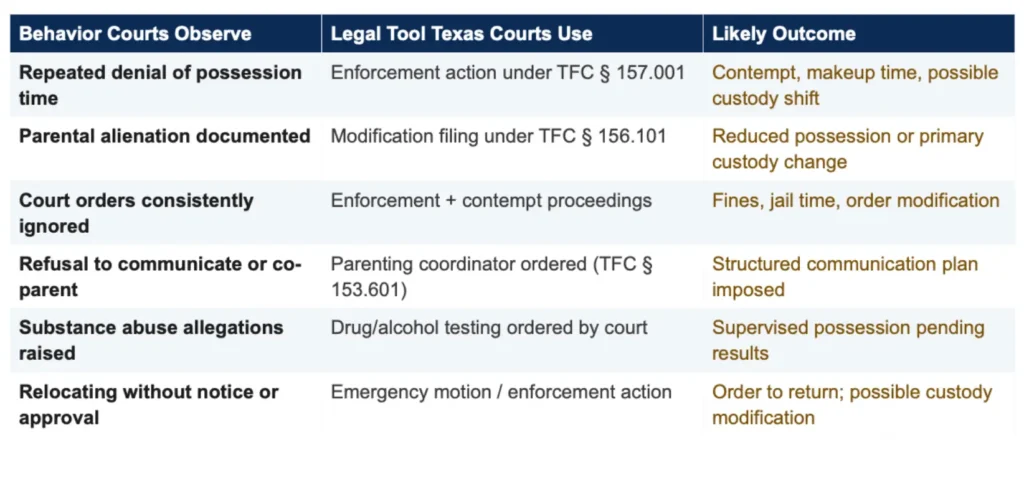
Texas courts do not rely on a single response in high-conflict custody situations. Judges have several legal tools available, and the one applied depends on the severity and pattern of the conduct.
The table below summarizes what courts commonly do when one parent refuses to cooperate.
Parental Alienation and What Texas Courts Do About It
Parental alienation is one of the most significant issues Texas family courts face in high-conflict custody disputes.
It refers to a pattern of behavior by one parent designed to damage or destroy the child’s relationship with the other parent.
This can range from regular negative comments to coaching the child to make false statements about the other parent.
Texas courts take alienation seriously because it runs counter to one of the core policy goals in Texas Family Code § 153.001: that children benefit from frequent, ongoing contact with both parents, who act in their best interests. If you can show a documented pattern of alienating behavior, courts have responded by:
- Reducing the alienating parent’s possession time
- Transferring primary conservatorship to the other parent in documented, severe cases
- Ordering the child and the alienating parent into family therapy
- Requiring communication to occur only through a court-monitored parenting app
Courts will not act on a vague claim that the other parent is alienating. You need specific incident dates, statements, what was said to the child, how the child responded,
and any professionals who have observed the behavior. Judges distinguish between alienation and a child who simply does not want to visit because of the conflict at home.
After reviewing how courts in Texas address uncooperative co-parents and alienation, some parents find it useful to speak with a family law attorney to assess whether their documented incidents are sufficient to support an enforcement action or a modification filing.
When a Custody Modification Becomes the Right Legal Step
If the other parent’s non-cooperation has reached a point where the current order is not working for your child, a custody modification may be the appropriate next step. In Texas, you can request a modification of conservatorship or possession when there has been a material and substantial change in circumstances since the last order was entered.
Circumstances that commonly support a modification request in high-conflict situations include:
- A documented pattern of order violations that the court has not yet addressed through enforcement
- Evidence of parental alienation affecting the child’s relationship with you
- A change in the other parent’s living situation, stability, or conduct
- The child’s own stated preferences, if the child is at least 12 years old
- Substance abuse, mental health concerns, or safety issues that have emerged since the original order
Under Texas Family Code § 153.601, courts can also order a parenting coordinator to manage ongoing conflicts, a step that often precedes or accompanies a modification filing when communication has broken down entirely.
A modification hearing is not guaranteed to result in a change; courts require evidence, not complaints. The stronger your documentation of specific incidents, dates, and impact on the child, the more your filing has to stand on.
How Courts Handle High-Conflict Custody Disputes in Texas
When one parent refuses to cooperate in a Texas custody arrangement, the law gives courts meaningful authority to respond.
From enforcement actions and contempt proceedings to parenting coordinators, modified possession schedules, and, in documented cases, full custody transfers, Texas judges are not without tools.
What matters most in these situations is what you can show, not just what you can say. Courts evaluate patterns of conduct over time.
Your documentation of missed exchanges, hostile communications, blocked access, and a child caught in the middle gives the court concrete grounds to act.
If you are dealing with a high-conflict custody situation in Texas and want to understand what options are available in your specific case,
Texas Divorce Attorneys can help you evaluate the documentation you have and what legal steps make sense given your circumstances. Call (612) 662-9393 or visit our Contact Us page to speak with our team.
Frequently Asked Questions
What counts as high conflict custody in Texas?
In Texas, a custody case is typically classified as high conflict when one or both parents engage in persistent behavior that goes beyond normal co-parenting disagreements. This includes repeated violations of possession orders, documented parental alienation, chronic refusal to communicate, repeated litigation over minor issues, or ongoing allegations of abuse, substance use, or neglect. Courts look for patterns over time, not isolated incidents, when evaluating whether a case has reached high conflict status.
Can a co-parent lose custody for not cooperating in Texas?
Yes, but the standard is a pattern of conduct, not a single incident. If your co-parent is consistently denying your court-ordered possession time, engaging in documented alienation, or repeatedly violating the terms of the conservatorship order, a Texas court can modify custody arrangements. The court can shift primary conservatorship to the more cooperative parent if the evidence shows the current arrangement no longer serves the child’s best interest.
What is a parenting coordinator in Texas, and when does a court order one?
A parenting coordinator is a licensed mental health or legal professional appointed under Texas Family Code § 153.601 to help high conflict parents resolve co-parenting disputes outside the courtroom. Courts typically order one when communication between parents has broken down entirely, when repeated enforcement actions have not resolved the conflict, or when the level of hostility is creating instability for the child. The coordinator does not decide custody, but they help implement the existing order and reduce ongoing conflict.
Can I modify custody if my co-parent keeps violating court orders in Texas?
Yes. Under Texas Family Code § 156.101, you can request a custody modification if there has been a material and substantial change in circumstances since the last order. Repeated, documented violations of the possession order can support that threshold. You can also file an enforcement action under TFC § 157.001 to hold the other parent in contempt, which is a faster route when the violation is specific and recent. Both options are often filed together in high-conflict situations.