
When comparing divorce vs annulment in Texas, you are evaluating whether the law treats your marriage as valid or invalid from the start. A divorce ends a legally recognized marriage, while an annulment declares that no valid marriage existed. Each option follows different legal standards, timelines, and requirements. Understanding these distinctions helps you determine which legal path may apply based on your situation under Texas family law and court procedures.
When your marriage is ending, you need to determine whether the law treats it as valid or invalid from the beginning. The difference between divorce vs annulment in Texas affects your legal rights, financial responsibilities, and future obligations. Each process applies in specific circumstances and follows different legal standards.
Texas Divorce Attorneys help explain how courts review marriages, apply annulment rules, and process divorces so you can better understand which legal option aligns with your situation and the facts of your case.
Divorce Ends Valid Marriage Under Texas Law
A divorce ends a legally valid marriage and allows courts to resolve financial and parental responsibilities. It applies when the marriage met legal requirements at the time it was created.
In Texas, divorce is commonly based on insupportability, meaning the relationship cannot continue due to conflict. Courts typically address:
- Property division
- Child custody and visitation
- Support obligations
According to Texas Family Code §6.001, insupportability is a recognized ground for divorce, allowing the court to dissolve a valid marriage through a structured legal process.
Annulment Declares Marriage Legally Invalid From Start
An annulment establishes that a valid marriage never existed. Instead of ending a marriage, the court determines that legal requirements for a valid marriage were not met when the marriage occurred.
Annulment eligibility Texas is limited to specific situations defined by law. These may include:
- Lack of legal capacity to consent
- Fraud, force, or duress affecting the marriage
- A prior undissolved marriage
- Concealment of important legal facts
Because these conditions are narrow, courts require clear proof before granting an annulment.
Key Differences Between Divorce And Annulment Outcomes
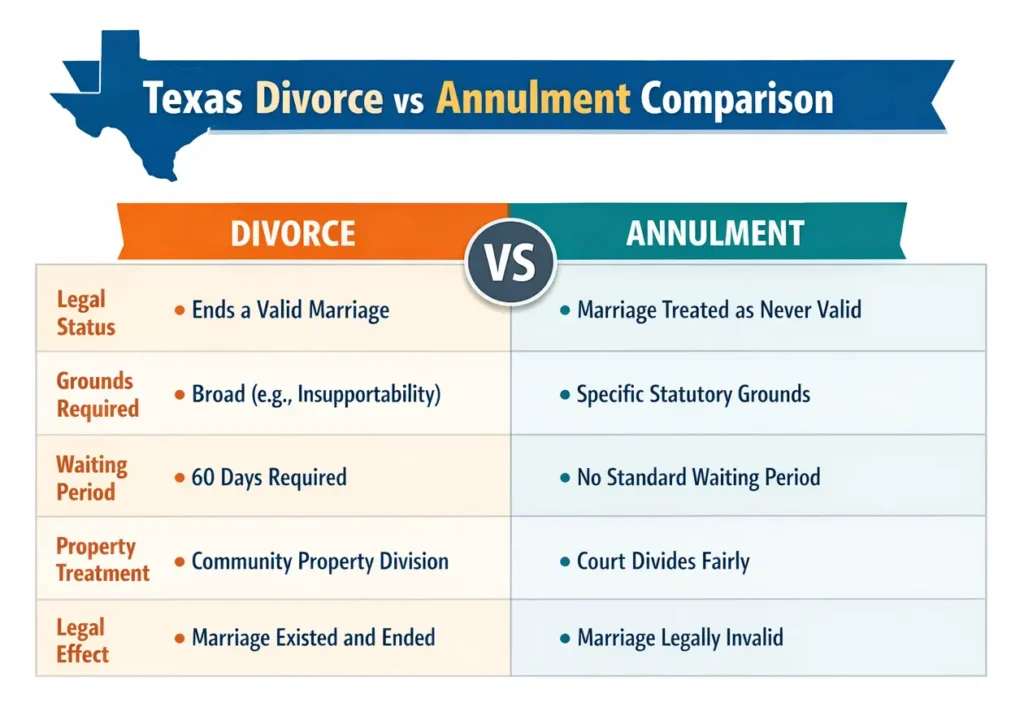
The difference between divorce vs annulment Texas determines how the law treats your marriage and its legal consequences. Divorce confirms a valid marriage existed and formally ends it, while annulment treats the marriage as legally invalid from the beginning.
These distinctions affect legal status, overall rights, and how courts treat the marriage. Understanding these differences helps you evaluate which legal process applies based on your circumstances.
Legal Grounds Required For Texas Annulment Cases
Annulment requires proof that legal requirements for a valid marriage were not met at the time it occurred. Courts review whether a specific legal condition existed and whether it affected consent or legality.
Because annulment eligibility is limited, the court focuses on whether the marriage itself failed to meet legal requirements rather than later relationship issues. This means annulment cases depend more on the specific situation than divorce cases.
Specific Conditions Courts Evaluate For Validity
Courts look for specific legal conditions that made the marriage invalid at the time it occurred. These conditions must directly affect consent or legal capacity for an annulment to be considered. This includes reviewing evidence tied to statutory grounds rather than general marital conflict.
Examples include:
- Fraud affecting agreement to marry
- Intoxication preventing informed consent
- Lack of mental capacity
Property Division Differences Between Divorce And Annulment
Property division depends on whether the marriage is treated as valid or invalid. In divorce, courts apply community property rules to divide assets acquired during the marriage.
In annulment cases, courts may treat the relationship differently because the marriage is considered invalid. However, judges still divide property in a manner that is fair based on the circumstances.
This distinction affects:
- Ownership classification
- Debt responsibility
- Financial claims
Understanding these differences helps you evaluate how financial outcomes may be handled in each process.
Court Procedures And Filing Requirements In Texas
Divorce and annulment follow different steps in the case, even though both begin with filing a petition in court. Divorce includes broader eligibility and structured timelines, while annulment depends on proving specific legal grounds.
This means your case depends on:
- Whether the marriage is legally valid
- Whether annulment eligibility applies
- Whether waiting periods and filing requirements may affect your case
According to Texas Family Code §6.702, most divorce cases require a 60-day waiting period before finalization, which does not apply in the same way to annulment proceedings.
Final Perspective On Divorce Vs Annulment Texas
Understanding divorce vs annulment Texas helps clarify how the law treats your marriage and which legal process applies to your situation. Divorce ends a legally valid marriage and allows courts to address property division, support, and parental responsibilities. In contrast, annulment treats the marriage as if it never legally existed, but only when specific statutory conditions are met.
Each process follows different legal standards, timelines, and requirements, which can affect your financial and legal outcomes. Because annulment depends on strict eligibility rules, reviewing your circumstances carefully is important before deciding how to proceed.
Texas Divorce Attorneys can help explain how these distinctions apply based on your situation and how courts may evaluate your case. You may call (612) 662-9393 or visit the Contact Us page to learn more.
Frequently Asked Questions
Can annulment affect child custody or support decisions?
Yes, annulment can still involve child-related decisions even though the marriage is treated as invalid. Courts address custody, visitation, and child support based on the child’s best interests. When comparing divorce vs annulment Texas, parental responsibilities remain enforceable regardless of marital validity, and the court may issue orders to ensure the child’s needs are properly supported and protected.
Can a court deny an annulment even if the marriage was short?
Yes, the length of the marriage does not automatically determine whether annulment is available. A court focuses on whether a valid legal ground existed at the time of the marriage and whether the facts meet statutory requirements. Even very short marriages may still require divorce if annulment grounds cannot be proven.
Can a marriage be both void and voidable in Texas?
No, a marriage is classified as either void or voidable under Texas law, and this distinction affects how courts handle the case. Void marriages are considered invalid from the beginning without needing annulment, while voidable marriages may be declared invalid through annulment if specific legal conditions are proven. Courts review the facts carefully to determine the correct classification.
Is there a time limit to request annulment?
Yes, certain annulment grounds must be raised within a specific timeframe after the marriage or after discovering the issue. These deadlines depend on the legal basis, such as fraud or lack of capacity. Courts also consider whether the spouses continued living together after learning about the issue, which may affect whether annulment remains available.
Can annulment be based on fraud in every situation?
No, not every false statement or hidden issue will support an annulment. The fraud must relate to an important fact that affected the decision to marry, and the court will look at whether that issue directly influenced consent. General disappointment or later conflict usually does not meet the legal standard for annulment.