

When you compare contested vs uncontested divorce in Texas, the key difference is whether you and your spouse have resolved all issues. An uncontested divorce moves forward when you agree on property, parenting, and support. A contested divorce continues when disagreements remain. This difference affects court involvement, the number of steps required, and how long your divorce may take to finalize.
When you are going through a divorce, one of the first things to understand is whether your case involves agreement or ongoing disputes. Some couples are able to settle everything early, while others need the court to resolve disagreements.
Every divorce starts the same way, but the path changes depending on whether issues remain unresolved. Understanding this difference helps you anticipate what your case may involve. Texas Divorce Attorneys often help individuals evaluate how their situation may proceed based on these factors.
Key Differences Between Texas Divorce Process Paths
The main differences between contested vs uncontested divorce Texas involve agreement, court involvement, and who makes the final decisions in your case. This is often described as an agreed divorce vs contested divorce Texas comparison, where the key question is whether all terms are resolved before the court needs to step in.
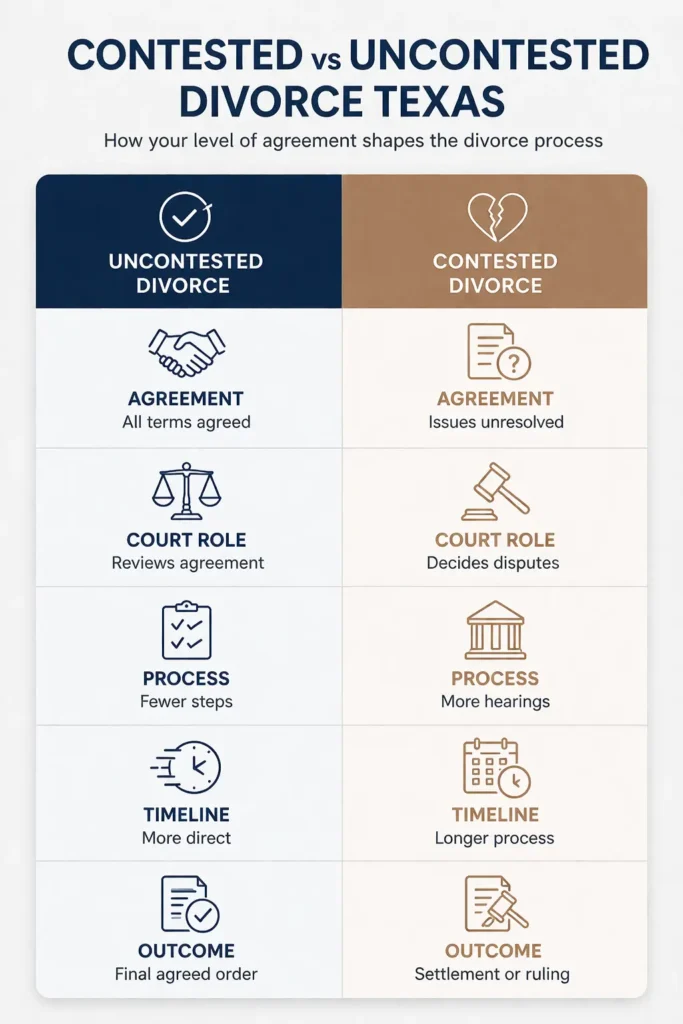
This comparison shows how your level of agreement affects how your divorce moves through the court system. Property division is a common difference between agreed and disputed cases.
Under Texas Family Code §3.003, property possessed during or at the end of marriage is presumed to be community property unless proven otherwise.
Agreement Determines Whether Your Divorce Is Contested
Whether your divorce is contested depends entirely on agreement, not how cooperative the situation feels. An uncontested divorce requires both spouses to agree on all required terms before the court signs the final order.
That includes property division, debt allocation, parenting schedules, child support, and any request for spousal maintenance. When everything is resolved, the court’s role is limited to reviewing and approving the agreement.
A contested divorce begins when even one issue remains unresolved. In that situation, the court may need to step in to review the case, consider evidence, and make decisions before the divorce can be finalized.
Common Disputes That Keep Divorce Cases Open
Certain disagreements are more likely to keep your divorce contested because they directly affect finances and parenting responsibilities. Even one unresolved issue can prevent your case from moving forward.
Property and debt disputes are common, especially when you and your spouse disagree on what is shared or how assets should be divided.
Parenting disagreements can also keep your case open. If you cannot agree on custody or schedules, the court focuses on your child’s best interest before making decisions.
Support issues may create similar delays. Disputes about child support or financial support often require clear terms before the court will finalize the case.
Courts Take Larger Roles In Disputed Cases
Courts take a larger role in your case when your divorce is contested because unresolved issues must be reviewed before the case can be finalized. The judge may need to address temporary arrangements, review documents, and evaluate each side’s position on property, parenting, or support. This added involvement is one reason contested divorces often take longer, while uncontested cases are generally more streamlined.
Mediation can narrow unresolved divorce issues
Mediation may help you resolve disagreements before your case reaches a final hearing. Courts may refer you and your spouse to mediation, and any agreement reached there can become binding if it meets legal requirements.
Even if your divorce starts as contested, mediation may help you settle property, parenting, or support issues. This can reduce conflict, simplify your case, and limit what the judge needs to decide later.
Uncontested Divorces Still Need Final Court Approval
Even if you and your spouse agree on everything, your divorce is not final until the court approves it. You still need complete paperwork, compliance with court procedures, and a final signed order.
Texas Family Code §6.702 generally requires you to wait at least 60 days after filing before your divorce can be finalized. During that time, the court reviews your case to make sure everything is complete and legally sufficient before issuing the final decree.
Final Thoughts On Texas Divorce Process Choices
Understanding contested vs uncontested divorce in Texas helps you evaluate what your case may involve before it moves forward. If you resolve all issues early, your divorce will usually be more direct and require less court involvement. If disagreements remain, your case may involve more steps before it is finalized.
Some divorces begin as contested but later become uncontested once agreements are reached. What matters most is whether all terms are fully resolved before the court issues a final order. If you need guidance, Texas Divorce Attorneys can help you understand how your case may proceed and what to expect next. You may contact us at (612) 662-9393 or visit the Contact Us page to learn more.
Frequently Asked Questions
Does filing first give you an advantage in divorce?
No, filing first does not automatically give you a legal advantage in the outcome of your divorce. It may give you more control over timing, preparation, and how the case is first presented to the court. In a contested vs uncontested divorce Texas situation, what matters more is whether you and your spouse resolve the major issues before the court has to decide them.
What happens if your spouse does not respond to the divorce?
If your spouse does not respond, your case may move forward as a default divorce instead of a contested one. That does not mean the divorce is automatic, because you still have to complete the required paperwork and prove you followed the correct steps. In many situations, a no-response case is simpler than a disputed one, but the court still has to approve the outcome.
Can a divorce change from contested to uncontested in Texas?
Yes, a divorce can shift from contested to uncontested if you and your spouse resolve all remaining issues before the final hearing. This often happens through negotiation or mediation. Once all terms are agreed upon and properly documented, the court may treat the case as uncontested, which can reduce the number of court proceedings and simplify how the divorce is finalized.
Do both spouses have to attend the final divorce hearing in Texas?
No, both spouses are not always required to attend the final hearing in an uncontested divorce. In many cases, only the filing spouse appears to present the agreement to the court. However, requirements can vary by county, and the judge must still review the terms to ensure they meet legal standards before signing the final decree.
What should you gather before deciding how your case may proceed?
You should gather financial records, account statements, debt information, property details, and any documents related to children before deciding how your case may proceed. This information helps you see whether you and your spouse are actually close to agreement or still far apart on important issues. The more clearly you understand the open issues, the easier it is to predict whether your divorce may stay disputed.