

Quick Summary
If you are preparing for a deposition in a Texas divorce, you can expect sworn questioning, detailed financial and personal inquiries, and recorded testimony that may be used later in court. Understanding this process helps you respond clearly and avoid inconsistencies.
When your divorce involves disagreements about finances, property division, or parenting arrangements, depositions often become part of the process. A deposition in a Texas divorce allows attorneys to ask you questions under oath before trial, and your responses may later be used to assess how reliable your statements are and support legal arguments. This step can shape how your case is prepared and presented.
Understanding how depositions function helps you approach questioning with clarity and structure. Texas Divorce Attorneys assist individuals by explaining procedures, outlining likely areas of questioning, and helping you prepare responses that align with Texas family law requirements. With proper preparation, you can answer accurately and reduce the risk of statements being misunderstood or used against you later.
Depositions Establish Sworn Testimony In Divorce Proceedings
In a deposition Texas divorce case, depositions establish sworn testimony before trial and allow both sides to better understand each party’s position. Your answers are recorded and may later be used in court to address inconsistencies or support certain claims.
Depositions give each party the opportunity to clarify facts and present accurate statements about financial and parenting matters. They also help ensure transparency throughout the pre-trial process.
Discovery procedures in Texas divorce cases are governed by the Texas Rules of Civil Procedure 192–205. Depositions are part of this process and allow attorneys to obtain sworn testimony, confirm details provided in documents, and identify areas that may require additional clarification before negotiations or trial.
Deposition Procedures Follow Structured Legal Requirements In Texas
A deposition follows a formal structure, even though it takes place outside a courtroom. You are placed under oath, and your responses are formally documented during the process.
This process typically includes:
- Receiving formal notice with the date and location
- Taking an oath to provide truthful answers
- Responding to attorney questions without a judge present
- Creating a transcript that may be referenced later
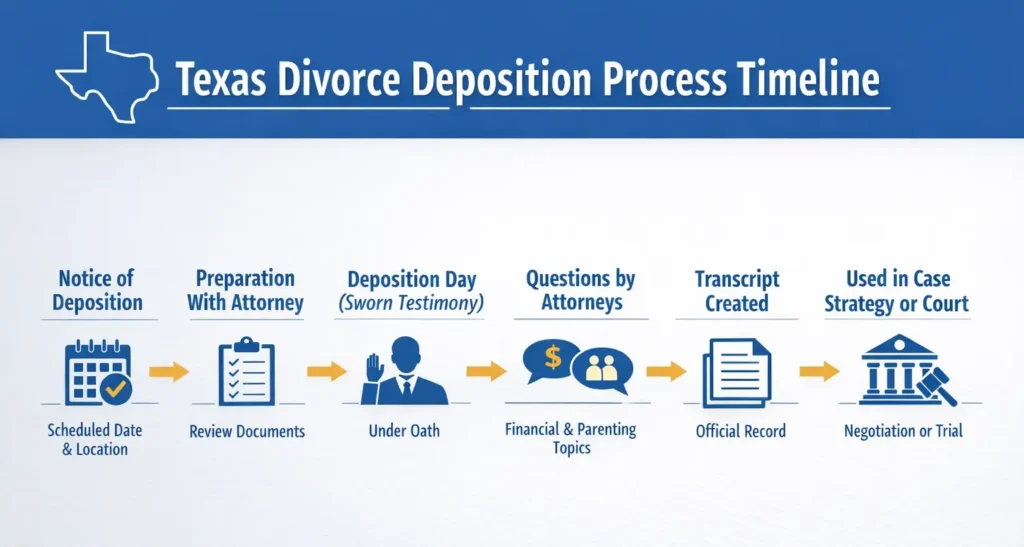
Although the setting is less formal than a courtroom, your testimony carries the same obligation for accuracy and truthfulness.
Deposition Questions Examine Financial And Personal Case Details
Deposition questions focus on details that directly affect property division, support, and parenting arrangements. You are expected to answer clearly and remain consistent with prior disclosures.
Attorneys use questioning to understand your position, verify information, and clarify disputed issues. This process focuses on how your answers align with your overall case and helps identify areas that may require further explanation before negotiations or trial.
Common Divorce Deposition Question Categories
Deposition questions are grouped into categories that reflect the main issues in your case. Your responses help attorneys assess accuracy and prepare for negotiation or trial.
Common categories include:
- Income, assets, and liabilities
- Ownership and transfer of property
- Parenting roles and daily responsibilities
- Communication between spouses
- Prior financial or legal disclosures
In many cases, divorce deposition questions Texas attorneys ask are designed to test whether your testimony aligns with documented evidence. Consistent answers help reduce the risk of challenges later in the case.
Deposition Testimony Influences Negotiation And Court Strategy
Your deposition testimony can influence how your case is negotiated and presented in court. Statements made under oath may later be used to support or challenge your claims.
Attorneys review deposition transcripts to identify strengths, weaknesses, and inconsistencies. This analysis helps shape legal strategy and may affect settlement discussions. When testimony remains consistent, it can support your position. When inconsistencies appear, they may be used to question reliability.
In cases involving children, deposition testimony may relate to parenting ability and decision-making. Under Texas Family Code §153.002, courts consider the best interest of the child when evaluating conservatorship issues.
After reviewing how deposition testimony can influence negotiation and trial strategy, some individuals choose to speak with a family law attorney to understand how these factors may apply to their specific case.
Preparation Improves Clarity And Consistency During Deposition Testimony
Preparing for a deposition helps you respond clearly and avoid confusion during questioning. You are not expected to memorize answers, but you should understand the details of your case.
Preparation allows you to organize your thoughts and stay consistent with prior statements. It also helps you avoid speculation or unnecessary explanations that could create misunderstandings.
Common preparation steps include:
- Reviewing financial documents and prior filings
- Practicing concise and direct responses
- Understanding the scope of likely questions
- Avoiding guesses when unsure
When you answer only what is asked and remain consistent, your testimony becomes easier to evaluate and less likely to be challenged.
Final Thoughts On Depositions In Texas Divorce Cases
A deposition Texas divorce process plays an important role in gathering sworn testimony and shaping how your case develops. Your answers can influence negotiations, clarify disputed issues, and affect how your credibility is evaluated during trial. Because depositions occur before court proceedings, they often reveal key details that impact financial and parenting outcomes.
Understanding how this process fits into your case helps you approach questioning with greater clarity and control. Preparation, consistency, and accurate responses remain central to how your testimony is interpreted under Texas family law procedures.
Taking time to understand the purpose and structure of a deposition can help you respond more effectively and avoid unnecessary risks during questioning. Texas Divorce Attorneys can help explain how these procedures apply to your situation. You may call (612) 662-9393 or visit the Contact Us page to learn more.
Frequently Asked Questions
How should you prepare mentally for a Texas divorce deposition?
To prepare mentally for a Texas divorce deposition, focus on staying calm and answering only what is asked. Pause before responding and avoid guessing or speculating. Review key facts about finances, property, and parenting arrangements in advance to improve clarity and reduce stress. Practicing with your attorney can help you feel confident, anticipate questions, and prevent misunderstandings, ensuring your testimony is accurate, consistent, and professionally delivered.
How long does a divorce deposition usually take?
A divorce deposition may last several hours or extend across multiple sessions depending on the complexity of the case. Cases involving significant assets, business interests, or contested custody arrangements often require longer questioning. The duration depends on how much information attorneys need to clarify and document before trial preparation, especially when multiple financial or parenting issues are involved.
Who can be present during a Texas divorce deposition?
Typically, a Texas divorce deposition includes your attorney, the opposing attorney, and a court reporter. In some cases, a videographer may also attend. Judges do not participate. Being aware of who is present helps you remain calm and professional, focus on providing accurate testimony, and avoid distractions. Understanding the roles of everyone in the room can make the process smoother and reduce stress during questioning.
Can a deposition be rescheduled if necessary?
Yes, a Texas divorce deposition can be rescheduled if necessary, either by mutual agreement, proper notice, or a court order. It’s important to notify your attorney promptly if a conflict arises. Courts generally allow reasonable adjustments, but repeated or last-minute requests may require formal motions. Planning ahead and coordinating schedules helps minimize disruptions and ensures the deposition proceeds efficiently while maintaining accuracy and compliance with procedural requirements.
What happens if you miss a deposition in a divorce case?
Missing a deposition in a deposition Texas divorce case can lead to legal consequences, including court orders requiring your attendance or possible sanctions. The opposing party may request that the court compel your participation, which can delay proceedings and increase costs. If you cannot attend as scheduled, it is important to communicate with your attorney in advance to request rescheduling through proper legal procedures.