

Quick Summary
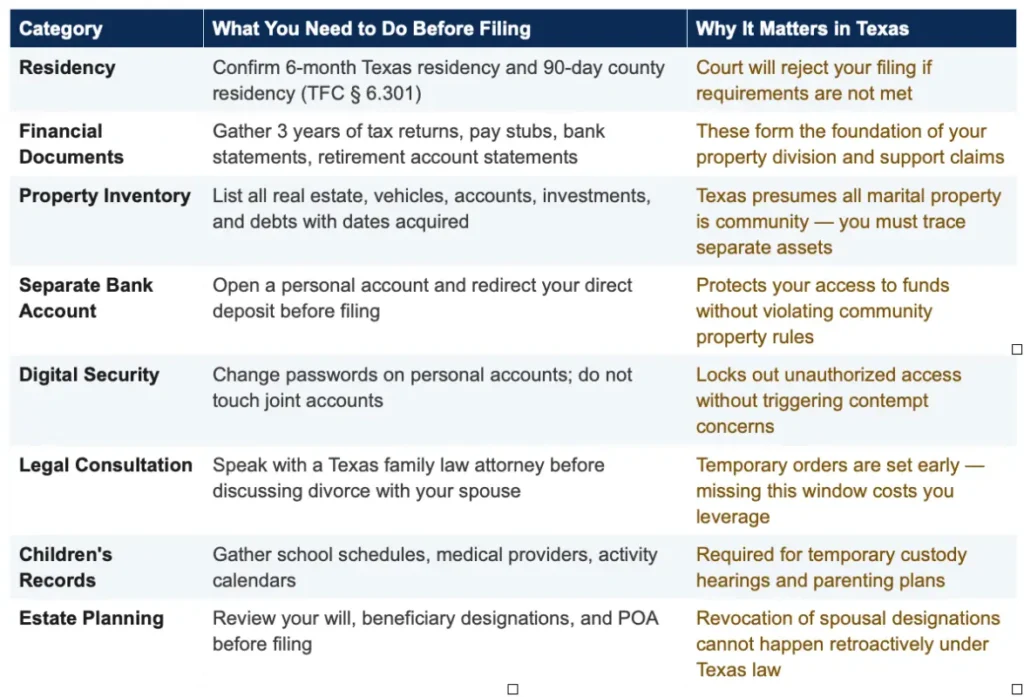
Before you file for divorce in Texas, specific steps, such as gathering financial records, opening separate accounts, and speaking with an attorney before your spouse does, can mean the difference between a strong starting position and one that costs you thousands to recover. This Texas divorce checklist walks through each step and explains exactly what is at stake financially.
Many people focus on the divorce filing itself, but the preparation that happens beforehand can significantly affect how the process unfolds.
In Texas, temporary orders addressing finances, living arrangements, and child-related issues may be entered shortly after a case begins, which is why early planning often matters.
Understanding what financial records to gather, what decisions may affect property division, and how temporary hearings work can help you better prepare before filing.
Texas Divorce Attorneys helps individuals understand the legal and financial considerations that commonly arise during the early stages of a Texas divorce. Speaking beforehand may help preserve options early.
What Texas Law Requires Before You Can Even File
Texas has firm residency requirements before any divorce petition can be accepted. Under Texas Family Code § 6.301, you or your spouse must have lived in Texas for at least six months before filing.
Additionally, one of you must have lived in the specific county where you plan to file for at least 90 days. If you file before meeting both requirements, the court may dismiss the petition, forcing you to pay filing fees again once you qualify.
Once filed, Texas imposes a mandatory 60-day waiting period under Texas Family Code § 6.702 before any judge can sign a final decree, even in a fully agreed case.
This 60-day clock matters for financial planning because temporary orders governing spousal support, housing costs, and account access remain in effect for the entire 60-day period.
There is no “legal separation” requirement in Texas; you do not need to be living apart to file. However, your living situation at the time of filing directly affects how a judge structures temporary possession of the house and parenting time. For the full statutory filing procedure, the Texas State Law Library offers a comprehensive divorce filing guide.
Know more about: Can You File for Divorce Without a Lawyer in Texas?
The Financial Documents You Must Gather First in Texas
Texas courts presume that everything acquired during the marriage is community property, meaning it is owned equally by both spouses.
The only way to counter this presumption is with clear documentation. If you cannot prove an asset is separate property (owned before marriage or received as a specific gift/inheritance), the court treats it as community property and divides it.
Gathering these records before filing, while both spouses still have routine access to shared accounts, protects you from paying forensic accountant fees later. Before you file, collect copies of:
- Tax Returns: Federal and state returns for the past three years.
- Income Proof: Pay stubs and employment documentation for both spouses.
- Bank Records: Statements for all accounts (joint and individual) for at least 12 months.
- Retirement Assets: 401(k), IRA, pension, and deferred compensation statements.
- Real Estate: Mortgage statements, deeds, and closing documents.
- Debt Records: All credit card statements and loan payoff balances
Know more about: How Texas Courts Handle Debt Division During Divorce
Why Retirement Accounts Carry the Highest Financial Risk
Retirement accounts, 401(k)s, IRAs, and pensions are frequently the single largest asset in a Texas divorce, often worth more than the marital home.
Dividing them requires a Qualified Domestic Relations Order (QDRO), a separate court order submitted directly to the plan administrator. If the QDRO is not drafted correctly, filed on time, and accepted by the plan, the division is unenforceable, meaning you lose your share of an asset that may represent decades of savings.
Beyond QDROs, retirement accounts are also a common site for financial misconduct during divorce proceedings. Early withdrawals taken without your knowledge reduce the balance before valuation.
Getting statements in hand before the filing date means you have a baseline that cannot be retroactively altered. If you discover a discrepancy later, you have the documentation to prove it.
How to Protect Your Finances Before the Filing Date
Protecting your finances is about ensuring independent access to funds from day one. The moment a divorce is filed, “Standing Orders” in many Texas counties (like Harris or Dallas) may restrict your ability to transfer or withdraw large sums of money.
Opening Separate Accounts Without Violating Texas Law
In Texas, you have the legal right to access your half of the community funds. Opening a separate bank account before filing and moving a proportionate share of liquid funds is generally permissible. However, draining accounts entirely or “hiding” money can lead to significant penalties, including the judge awarding your spouse a larger share of the remaining estate to settle the score.
Pre-Filing Financial Protections:
- Open a personal checking account: Redirect your direct deposit here so your income isn’t trapped in a joint account.
- Apply for a personal credit card: This ensures you have an independent credit line for legal fees or living expenses.
- Document current balances: Take dated screenshots of all joint accounts to prevent disputes over moved funds.
- Secure your mail: Set up a P.O. Box for attorney correspondence to maintain confidentiality.
For more on how our firm handles financial preparation in Texas divorce cases, visit our contact us page or call us directly at (612) 662-9393 to connect with our team.
Why Temporary Orders in Texas Are Set Fast
Within days of a filing, either spouse can request a Temporary Orders Hearing. A judge then issues binding orders covering who stays in the home, who pays the mortgage, and who has primary custody of the children.
These orders remain in effect until the final decree, which could be over a year away. Showing up to this hearing without the preparation your spouse’s attorney has already done can lead to unfavorable terms that drain your resources.
Protecting Your Children's Situation Before You File
When children are involved, the temporary orders hearing is also a financial hearing. The parent who receives temporary primary possession typically receives child support calculated under the Texas Family Code’s percentage guidelines.
Steps to Take:
- Keep a log: Document your daily involvement in school drop-offs, medical visits, and homework.
- Gather records: Collect school schedules and medical provider information.
- Maintain routine: Do not move children out of the family home or change their school abruptly before filing, as this can reflect poorly on your stability.
Estate Planning and Digital Security Steps Before Filing
Estate Planning: Under current law, your spouse remains your beneficiary on life insurance and retirement accounts until the divorce is final or documents are changed. Review your will and Power of Attorney before filing.
Digital Security: Change passwords on all personal accounts. However, do not change passwords on joint accounts, as courts may view this as an attempt to block your spouse from community information.
External Resource: For more on digital safety, the Texas Council on Family Violence provides resources on tech safety during litigation.
Why Preparation Before Filing for Divorce in Texas Matters
The steps you take before filing for divorce in Texas can directly affect your financial outcome during the case. Temporary orders entered early may impact support, custody, property access, and financial obligations for months or longer.
Missing retirement account contributions, failing to organize financial records, or entering court unprepared can lead to costly consequences that are difficult to reverse later. This Texas divorce checklist is designed to help you better understand the practical and financial considerations that often arise before filing.
Texas Divorce Attorneys work with clients at the pre-filing stage across Texas, helping them understand the legal requirements, assess their financial position, and take the right steps before the case begins. Call (612) 662-9393 or visit our Contact Us page to speak with our team.
Frequently Asked Questions
How long do you have to live in Texas before filing for divorce?
Under Texas law, either you or your spouse must have lived in Texas for at least six months before filing for divorce. In addition, one spouse must have lived in the county where the case is filed for at least 90 days. Filing before meeting both residency requirements can result in dismissal and require you to pay filing fees again.
Should I move out of the house before filing for divorce in Texas?
Moving out before filing can affect temporary housing, finances, and custody issues in Texas. Judges may treat your departure as support for the other spouse remaining in the home, and your departure may affect temporary parenting arrangements. Because housing and parenting decisions are often part of what to do before filing for divorce in Texas, this decision should be made carefully.
Can I empty a joint bank account before filing for divorce in Texas?
You may be able to withdraw a reasonable share of funds from a joint bank account before divorce, but draining the account entirely can create serious problems. Texas courts may treat excessive withdrawals as financial misconduct and compensate the other spouse during property division. Careful documentation and proportional withdrawals are generally important when handling joint marital funds.
Does it matter who files for divorce first in Texas?
Filing first does not automatically affect property division in Texas, but it can provide procedural advantages. The filing spouse may request temporary orders earlier, shape the initial presentation of the case, and select the filing county when multiple venues are available. These advantages can influence strategy in contested divorces involving custody or significant assets.
How long does a divorce take in Texas after filing?
Texas imposes a minimum 60-day waiting period before a divorce can be finalized. Uncontested cases may conclude shortly after that period, while contested divorces often take six months to two years or longer, depending on complexity, court schedules, and disputed issues. Temporary orders may govern finances and parenting during the case. If you need guidance, please contact us or call (612) 662-9393.